With reluctance, we must revisit an unpleasant part of the history of the DAR.
In the pursuit of restoration of the Daughters of the American Revolution to being a women’s only organization, claims are made that because the DAR has a history of racial discrimination, the DAR cannot now be seen as discriminating against “transwomen.”
Those who oppose our effort often invoke the name of Marian Anderson, world renowned, black contralto who was denied the ability to perform at Constitution Hall in 1939. She was not denied membership in the DAR.
Controversary ensued and there was a great public outcry. Some believe that the DAR was used as a pawn in a publicity stunt orchestrated by Ms. Anderson’s agent, Sol Hurok.
It is true that seven years earlier in 1932, the Executive Committee of the DAR decided to add the words “white artists only” to the lease for the use of Constitution Hall.
Many appeals were made to the management of Constitution Hall and even to the President General from various prominent people asking that an exception for the use of the hall be made for Ms. Anderson.
These many appeals were denied by the President General and in fact, on February 1, 1939, the National Board of Management, by a vote of 39 to 1, adopted a recommendation from the National Executive Committee “that the rules governing contracts for the use of Constitution Hall be continued.”
In her daily column, “My Day,” dated February 27, 1939, First Lady Eleanor Roosevelt wrote:
“I have been debating in my mind for some time, a question which I have had to debate with myself once or twice before in my life. Usually I have decided differently from the way in which I am deciding now. The question is, if you belong to an organization and disapprove of an action which is typical of a policy, should you resign or is it better to work for a changed point of view within the organization? In the past, when I was able to work actively in any organization to which I belonged, I have usually stayed in until I had at least made a fight and had been defeated.
Even then, I have, as a rule, accepted my defeat and decided I was wrong or, perhaps, a little too far ahead of the thinking of the majority at that time. I have often found that the thing in which I was interested was done some years later. But, in this case, I belong to an organization in which I can do no active work. They have taken an action which has been widely talked of in the press. To remain as a member implies approval of that action, and therefore I am resigning.”
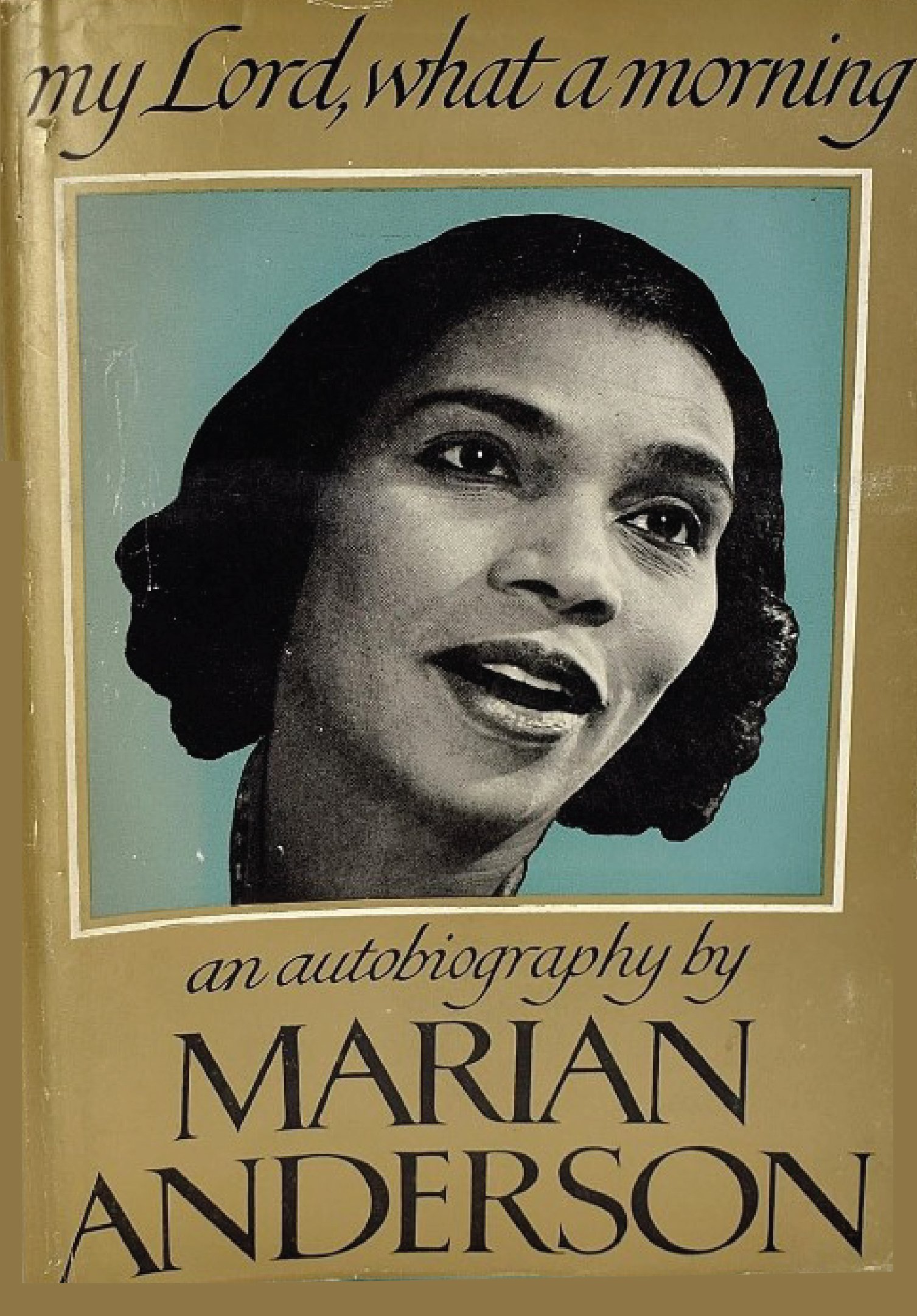
In her autobiography My Lord, What a Morning Ms. Anderson wrote of the incident:
“It was only a few weeks before the scheduled date for Washington that I discovered the full truth – that the Daughters of the American Revolution, owners of the hall, had decreed that it could not be used by one of my race. I was saddened, but as it is my belief that right will win I assumed that a way would be found. I had no inkling that the thing would become a cause célèbre.”
She goes on to say…
“The excitement over the denial of Constitution Hall to me did not die down. It seemed to increase and to follow me wherever I went. I felt about the affair as about an election campaign; whatever the outcome, there is bound to be unpleasantness and embarrassment. I could not escape it, of course. My friends wanted to discuss it, and even strangers went out of their way to express their strong feelings of sympathy and support.
What were my own feelings? I was saddened and ashamed. I was sorry for the people who had precipitated the affair. I felt that their behavior stemmed from a lack of understanding. They were not persecuting me personally or as a representative of my people so much as they were doing something that was neither sensible nor good. Could I have erased the bitterness, I would have done so gladly.”
Later she goes on:
“It was touching to have concrete expressions of support for an essential principle. It was touching to hear from a local manager in a Texas city that a block of two hundred tickets had been purchased by the community’s D.A.R. people. It was so heartening; it confirmed my conviction that a whole group should not be condemned because an individual or section of the group does a thing that is not right.”
She is gracious in her assessment saying
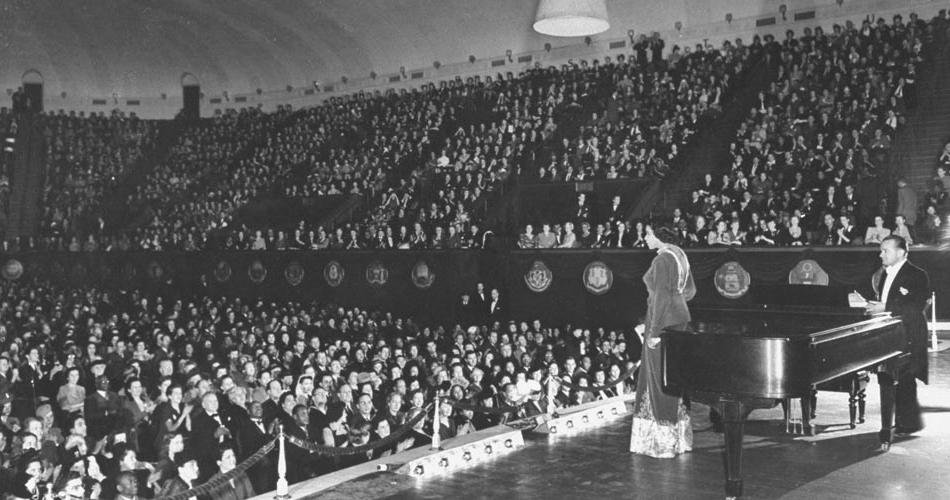
“In time the policy at Constitution Hall changed. I appeared there first in a concert for the benefit of China Relief. The second appearance in the hall, I believe, was also under charitable auspices. Then, at last, I appeared in the hall as does any other musical performer, presented by a concert manager, and I have been appearing in it regularly. The hall is open to other performers of my group. There is no longer an issue, and that is good…
…May I say that when I finally walked into Constitution Hall and sang from its stage I had no feeling different from what I have in other halls. There was no sense of triumph. I felt that it was a beautiful concert hall, and I was happy to sing in it.”
Comparing the racial discrimination of a black women done so by the Executive Committee and National Board of Management in 1939 to that of current day members seeking to maintain the integrity of what it even means to be a woman is flawed.
First, the denial of the use of Constitution Hall would today be a violation of Title II of the Civil Rights Act of 1964 which prohibits discrimination in places of public accommodation like hotels, theaters and restaurants.
Daughters advocating for restoration of the DAR understand the difference between the DAR in its capacity as a place of public accommodation versus its capacity as a private member association. In fact, even the former President General understands this difference as well.
“In addition to being a public accommodation and employer, DAR is also a private member association. Its membership policies are generally considered outside of the scope of anti-discrimination laws when membership is restricted to people who share a protected characteristic – in this case, women.” -(Answers to Frequently Asked Members Questions Regarding Transgender Women in DAR #6, produced and disseminated by Former President General Pamela Wright)
Second, and most importantly, comparing men who demand admittance to a historically women’s only society under the premise that they are actually women, to black women is foolish, unreasonable, and offensive. To make this comparison is shameful and indefensible.
The only accurate comparison that can be made to the current predicament and the incident with Marian Anderson is to that of the decision makers in each of these scenarios and their excuses made and vague claim that “we must comply with applicable law.”
Recall that the Executive Committee first instituted the “white artists only” policy in 1932 and seven years later, the National Board of Management made the decisions to continue to restrict the use of Constitution Hall to whites only.
This was not a decision made by the Assembly at any Continental Congress.
In fact, records show that many members were angry about this policy decision and felt that the general membership should have had a say so in this policy.
Member Clara Hill of Norwalk, Connecticut wrote the following:
“As a member for forty-six years of the Society I wish to join my protest to those of many others against the actions of some individuals or committee which has put our Society so terribly in the wrong…
…I joined the Society in 1892 when my mother organized the Norwalk Chapter…
…I do no want to be forced to give up my loyalty to the Society because of its disloyalty to and denial of the principles for which it should stand, the Declaration of Independence, the Constitution of the United States and the Bill of Rights, but it is most mortifying to be obliged to apologize for and try to explain away (as I have had to do many times) actions which are entirely out of harmony with the spirit upon which the organization was founded.”
On March 25, 1939, Miss Hill received a response from the Secretary to the President General. It is troubling in two ways:
First, she replies that “Constitution Hall was already engaged by another musical organization for Easter Sunday when the request for its use by the artist as mentioned in your letter was received.”
This response was often initially given as the reason why Ms. Anderson was denied the use of the hall, but when other dates were suggested, the real reason was revealed that no matter the date, Constitution Hall was restricted to the use of white artists only which begs the question of why the DAR leadership mentioned this reason at all. We can draw our own conclusions that this was an excuse made in hope of diminishing the growing outrage.
Second, the letter goes on to make vague references to the law stating that “The rules governing the use of Constitution Hall are of seven years standing, and are in accordance with the policy of theaters, auditoriums, hotels and public schools of the District of Columbia. Separate public schools, playgrounds, and public recreational facilities are established within the District of Columbia by regulations adopted under the authority of law.”
Another member, Amy Perkins of the Ann Story Chapter wrote:
“Your form letter addressed to chapter regents in regard to the Anderson incident was read at a meeting of the executive board of Ann Story Chapter yesterday afternoon.
As an explanation, or justification, of the attitude and action of the national management of the D.A.R. in relation to that incident, I find your letter entirely inadequate, as it is both ambiguous and inconsistent.
Ambiguous, because it refers to rules of the organization and laws of the District of Columbia, without stating the rules or who was responsible for making them, and without specifying the laws of the District of Columbia which might be construed as applying to the case in point… (emphasis added)
Inconsistent, because, if this matter of rules and laws does adequately explain the attitude and action of the national management, there was no point in bring [sic] up the matter of rental dates at all…
…I feel that the inept handling of the whole affair by the national management has made the D.A.R appear ridiculous, if not actually un-American.
If the Anderson incident resulted from a matter of policy, I am in favor of changing that policy. If it resulted from rules not laid down with the concurrence of the entire organization, I favor an investigation and representative action by the organization. If it resulted from rules formulated with full understanding of their effect by representative vote, and if these rules continue to receive the support of a majority of the members of the organization, I no longer care to be a member.”
The incident even drew the attention of law makers. Senator Ernest W. Gibson of Vermont wrote the following to President General Robert:
“I am in receipt of a request from a constituent for information as regards the action of the D.A.R organization relating to the refusal to rent the Constitution Hall to Marion Anderson for a concert. I understand this action was taken in conformity with the laws of the District of Columbia, and I would greatly appreciate it if you would advise me to which of the District Laws this might refer.” (emphasis added)
It does not appear that the President General responded with an answer to this question.
The old saying that history repeats itself rings true.
Because the modern day policy of the DAR to recognize men as women is indefensible on its own merit, just as the policy to limit the use of Constitution Hall to white artists only was indefensible on its own merit, DAR National Executive Officers and the National Board of Management instead make excuses that fall flat, then claim that we must “comply with the law” by granting men with an amended birth certificate membership in the DAR.
They do this in vagaries without ever citing any actual law – exactly as they did in 1939 when public pressure mounted over the National Board of Management’s decision to keep the “white artists only” policy in place.
While it is very unpleasant to revisit this difficult incident in our history, it is only done so because those who would see our beloved DAR fundamentally and forever changed use this incident with Marian Anderson as a cudgel to silence members and prohibit free, fair and open debate.
The common thread in this incident with Marian Anderson and the predicament we find ourselves in today is that the National Board of Management was on the wrong side of history in 1939 and they are on the wrong side of history now.
Members of the DAR demand a fair, free, open debate and vote.
We are confident that had the women all across the country who make up the National Society of the Daughters of the American Revolution, had their voices heard and been able to vote, they would have made the right decision in 1939.
We demand a vote now in determining how we interpret our own bylaws and what it even means to be a Daughter of the American Revolution.
As the most prominent women’s genealogical society, founded on our shared pride in our American Revolutionary War heritage, we have an opportunity to lead in an enlightened way in the pursuit of historic preservation and most importantly, truth.
“You have set an example which seems to me unfortunate, and I feel obliged to send in to you my resignation. You had an opportunity to lead in an enlightened way and it seems to me that your organization has failed.”

No Responses