As an adult, I have been through enough trials to realize the goodness and mercy of God.
I was fortunate to learn at an early age that all we do in this life is but vanity if not done in pursuit of and in obedience to God’s ultimate will and glory.
When I first joined the DAR in 2018, I could be counted among those that Mrs. Minor names below in her address to the 27th Continental Congress as entering into the organization because I “have the required ancestry.”
Patriotic pride in my heritage I had in spades, but I had no inclination of just how much more it meant to be a Daughter of the American Revolution.
In addition to being a genealogical society, the DAR is a service organization. Members volunteer their time and abilities in countless ways. Honoring veterans and active duty military, making donations to women’s shelters and nursing homes, delivering patriotic programs and scholarships to students, and cleaning headstones are just a few of the ways DAR members serve. Sometimes their acts of service even reach across the globe.
The women who make up the DAR volunteer their time, not for recognition or for a pat on the back, but to serve and help those in need all while promoting the high ideals the United States of America was founded upon – the values of Christianity.
Sadly, it seems that the DAR has lost its way in recent decades – focusing more on the temporal rather than the eternal.
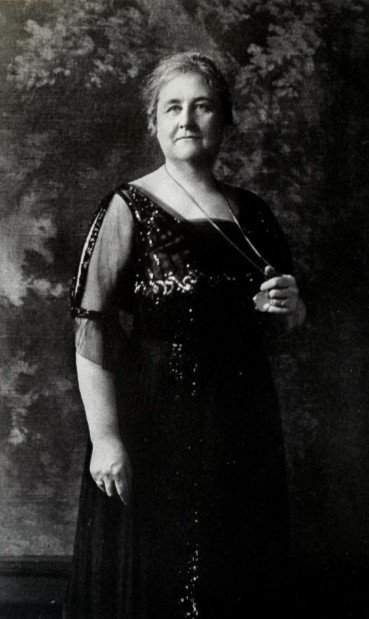
When researching other aspects of the history of the DAR, I stumbled upon this informative, inspiring and very moving address titled “The Deeper Meaning of our Daughters of the American Revolution Organization” given by Anne Rogers Minor in 1918 at the 27th Continental Congress. Mrs. Minor would later become President General, presiding from 1920 to 1923.
The contributions the Daughters have made to our country, especially in times of great turmoil are immeasurable. Mrs. Minor gives a riveting account in her message. It’s a bit of a long read, but worth every second. I have added my own emphasis.
Quoting from her address:
She that is faithful in that which is least is faithful also in much, and who can tell what some seemingly trifling service in a Chapter may mean when reckoned up from the viewpoint of the spiritual?
The deeper meanings of the Society are not to be sounded by the plumb line of the merely practical.
They are vibrant with the harmonies of the spirit and strike the chords of higher melodies.
In the broadening of human sympathies; in the development of individual powers; in the ennobling of woman’s work and influence, and in the larger view of service are to be found the higher ideals and best influences of the Society.
That the service of the home is not confined within the four walls of the house; that the service of the country is not confined within army posts or battlefields, even in war time; that the service of God cannot be bounded by the four walls of the church, but lies out in the open in our every-day lives — these are the Society’s deeper meanings which should inspire every Daughter of the American Revolution.
You can access the full address here.
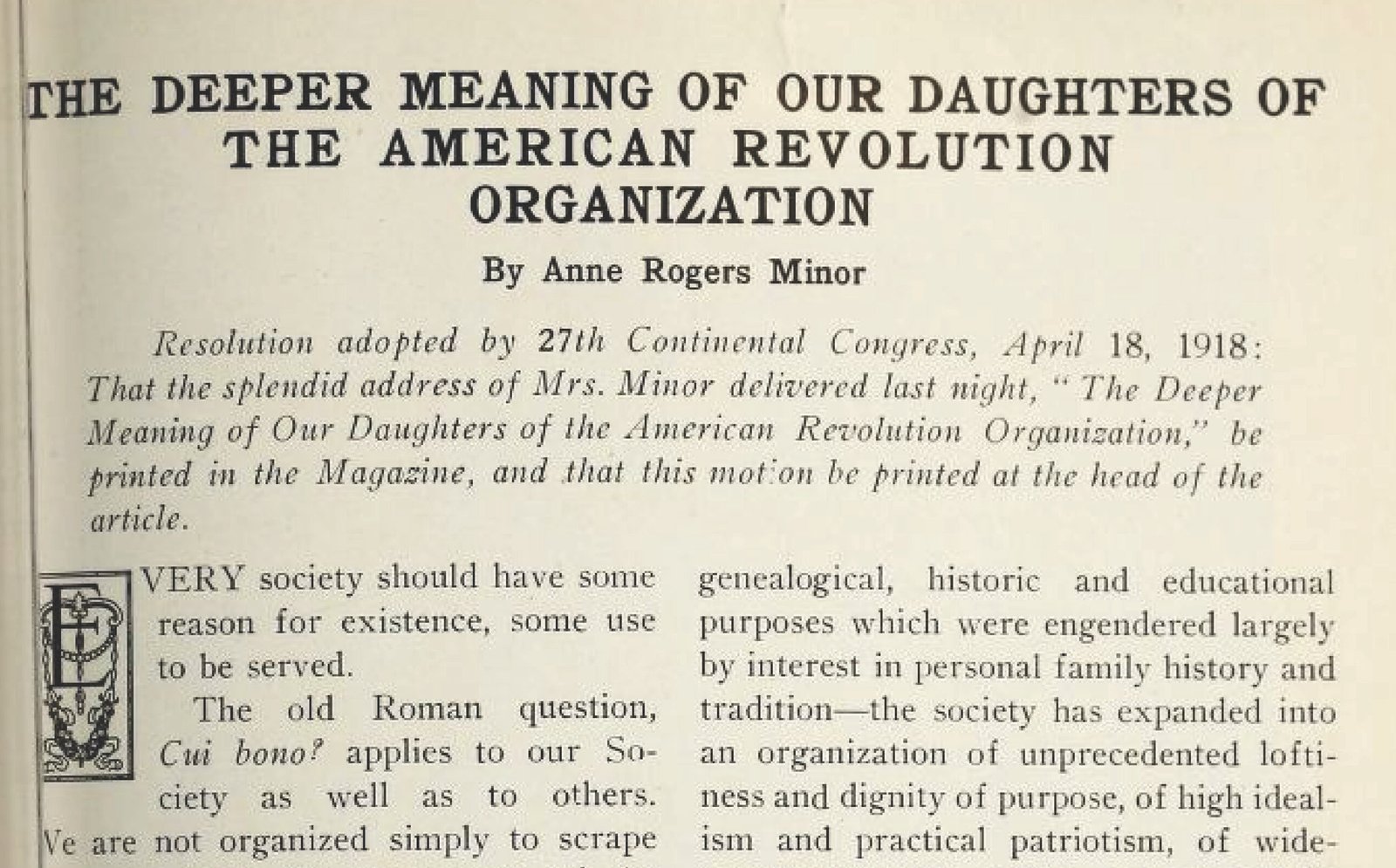
THE DEEPER MEANING OF OUR DAUGHTERS OF THE AMERICAN REVOLUTION ORGANIZATION
By Anne Rogers Minor
Resolution adopted by the 27th Continental Congress, April 18, 1918: That the splendid address of Mrs. Minor delivered last night, “The Deeper Meaning of Our Daughters of the American Revolution Organization,” be printed in the Magazine, and that this motion be printed at the head of the article.
Every society should have some reason for existence, some use to be served.
The old Roman question, Cui bono? applies to our Society as well as to others.
We are not organized simply to scrape the moss from the monuments of the dead lest they be forgot. We are to perpetuate the noble qualities of those who have gone before us as well as their memories.
Many who enter our organization have no conception of what it means to be a Daughter of the American Revolution. They enter for various reasons, because they have the required ancestry; or because they want the social privileges; or because some local advantage is to be gained by becoming a member of the local chapter; or for some other reason which falls far short of what should be the underlying motive of membership. These come to the social gatherings but avoid the business meetings.
They do not care for the business of the Chapter; in other words, they shun the work it was organized to accomplish. They remain blissfully unconscious of the broader fields of State and National work. They fail to realize the deeper meaning of the organization.
Begun twenty-seven and one-half years ago by a mere handful of women, for genealogical, historic and educational purposes which were engendered largely by interest in personal family history and tradition — the society has expanded into an organization of unprecedented loftiness and dignity of purpose, of high idealism and practical patriotism, of widespread influence within and without its own ranks. With a membership roll of over one hundred and two thousand covering every State in the Union and reaching into foreign lands; with a marble building erected out of its own funds as a memorial to the founders of this country wherein it maintains an organized office staff of high ability: with an income of over one hundred thousand dollars a year — what has this Society done to justify its existence — what have been the results of its organization; who has been benefited? Of what use has it been? The results may be regarded as threefold: the tangible, practical work accomplished along memorial, commemorative and educational lines; the educational, moral and spiritual influence of the organization upon society at large, and its educational, moral and spiritual influence upon its own membership.
The practical work of the Society would consume more than an evening in the telling. It fills eighteen volumes of reports to the United States Government – reports which are printed as Senate documents and which the Society must render annually or suffer a forfeiture of its charter.
Now, the United States Government has no interest in printing accounts of social functions or feminine trivialities; it wants solid work of some practical value to the country, historically or educationally. The Society has accomplished such work. Memorial Continental Hall would alone be sufficient proof of it. This building is in itself not only a splendid memorial to the men and women patriots of the Revolution: it is also an enduring monument to the patriotic efficiency and enterprise of the women of to-day in general and of the women of the Society in particular, who alone financed and built it without outside aid. This property of the Daughters of the American Revolution, valued at three-quarters of a million dollars, is held under a charter granted by the United States Government— the only one of its kind granted to any patriotic society — and is free from taxation by special act of Congress on the ground of the aims and purposes of the society in promoting ideals of public service and patriotism. This means something; it means that the owners of this building, the one hundred and two thousand and more Daughters of the American Revolution throughout this country, stand for something the United States Government holds to be valuable to the country.
To own even a one-hundred-thousandth share in this building is one of the deeper meanings of membership in the organization. Daughters whose sympathies are limited to their own localities have but little conception of the national influence and inspiration of such a building.
They see in it, perhaps, an extravagant headquarters for the national officers. We national officers see in it the crowning achievement of the whole society, in which every Chapter and every Daughter has a share, binding each to all and all to each in the bonds of a common purpose. We see the Daughters from every State congregated here within these walls bringing their record of State and local work for home and country and gaining that inspiration and enthusiasm which can come only from contact with one another. From the vantage point of Memorial Continental Hall we get the broader vision of the Society’s work throughout the country. We see the monuments and other memorials erected; the cemeteries restored; the fast vanishing record preserved; the historic trails, sites and houses marked; Revolutionary soldiers’ records preserved and graves located and marked; histories written and historic events commemorated; and finally the great movement throughout the Society towards patriotic education the training of the heterogeneous mass of our people in the duties and privileges of American citizenship and the moral and practical ideals of American life.
Under this latter head belong the scholarships scattered broadcast among the Southern Mountains, Connecticut’s famous Guide Book for the Education of the Immigrant, the Societies of the Children of the American Revolution — all of them teaching self-government, civic pride and good citizenship to the rising generation; prizes offered in the public schools and to foreigners in the night schools; welfare work among women and children upon whose weak shoulders depend the destinies of the nation and the nation’s homes; teaching reverence for the flag and keeping watch against acts of desecration; inculcating a more sensible and impressive and less crude observance of Independence Day; and now in the great world war for the principles of our forefathers and of our foremothers, mobilizing our full personal and financial strength in the service of our government, dedicating “all that we have and all that we are” to our country in arms for liberty and humanity. For all these things Continental Hall stands to-day, the outward and visible token of the Society’s work throughout the country, wherever a Daughter of the American Revolution Chapter exists; it typifies practical patriotism and unselfish service. Its erection has meant real sacrifice for many members. It was not built in a day. It has taken years of slow accumulation of capital, of wise planning, of sound financing and then the steady uphill work of paying off the bonded debt.
Projected in the earliest days of the Society as a fireproof depository for our priceless records and relics, it realizes to-day the far-reaching vision of our founders who dreamed a dream and builded a marble castle, not in Spain, but on the banks of the Potomac and then led us all “to put foundations under it.”
In selecting a site; in the method of selecting an architect and his plans; in raising the money, at first slowly by donations then rapidly by loans; in contracting with builders and passing on their work; in furnishing the Hall; acquiring all but a little piece of the remainder of the block on which it stands, and now in managing the completed property, there has been shown an amount of business ability not ordinarily supposed to be possessed by women. For thirteen years the Society had been slowly collecting its building fund, composed of freewill offerings from the Chapters throughout the country, brought here to Congress each year as to a shrine. In 1902 the site was purchased for $50,000 and the first sod turned with fitting ceremony by Mrs. Fairbanks, President General, on October 11, a flag pole and flag being raised to mark the spot.
At the following Congress, in February, 1903, the Continental Hall Committee, speaking through Mrs. Fairbanks, announced the exemption of our property from taxation by the United States Government on the ground, as I said, of our patriotic purposes and Government recognition as evidenced by our charter granted by the United States Congress and our obligation to report annually to the Smithsonian Institution and thence to the United States Senate. Fifteen years later, in this fateful winter of 1918, an inexorable fuel administration, merciless toward all but government agencies and the vital domestic needs of the people and of the nation at war, exempted Memorial Continental Hall from coalless days, again on the ground that we are a branch of the Government engaged in patriotic work of recognized value to the nation and also because we are raising $100,000 for the Third Liberty Loan. There is no society in this country, not even the Red Cross, that can outrank the Daughters of the American Revolution as an established Government agency and as a permanent factor in the life of this nation, which through its very nature must endure long after other societies, the outcome of some sporadic need shall have vanished away. The far-reaching vision of those who bought the site needs no further proof than to look at our surroundings to-day; and far-reaching it was indeed when one remembers the wind-swept boggy waste where the sod was turned by Mrs. Fairbanks’ spade on that October day of 1902. Far-reaching also was the vision and sublime the faith of that Congress of 1903 when it began to build a $450,000 proposition with the $84,000 then in the building fund. But they began, and in 1904, amidst a furious gale of wind, the corner-stone was laid with Masonic pomp and ceremony and cemented in place with the trowel once used by Washington. The building went rapidly on through that year until April,1905, when the first Congress was held within its walls — literally walls — as no permanent roof was then over the heads of the delegates, and Mrs. Fairbanks said good-by to her work, leaving Mrs. McLean to carry it on. As money from contributions came in too slowly to keep pace with the building contracts Mrs. McLean suggested and carried out the wise business measure of borrowing the remaining money, which resulted in the finished structure under the administration of Mrs. Matthew T. Scott.
The furnishing under Mrs. Scott was brought to such rapid completion that in 1910 Congress assembled under its own roof tree fully equipped for the business of the Society. Mrs. Scott also began to raise the debt; this work was carried on during the administration of Mrs. Story, the final payment being raised at our last (26th) Congress.
Mrs. Story also began the acquisition of the land back of the Hall, a work now practically completed by our President General, Mrs. Guernsey, and now for the first time we are meeting in a building free from debt; for the first time we have not needed to come here laden with gifts for Continental Hall. It is an accomplished fact, sprung from an idea that was born a quarter of a century and more ago. It was no superficial, hasty idea, this conception of Continental Hall; it was no evanescent sentiment, but a conviction firm as stell [steel]and clear as truth that the unnumbered and unknown dead, the unrecorded toils and sacrifices of all the men of the line and of all the women of the spinning wheel should at last be remembered, not by some vain and useless mausoleum, but by a building dedicated to the uses of patriotism and to the inspiration of future generations in their work for liberty and the ideals of the Republic.
Not alone is this, our Hall, erected to the honor of the dead who loved freedom more than wealth or power, but it is also for the living to make use of in their work of perpetuating their spirit and upholding their ideals throughout all coming generations. And to-day we are meeting here, a Society in arms for those ideals; we are in arms for the principles for which our ancestors fought. We are, please God, emulating and perpetuating their spirit. We stand ready to make sacrifices such as theirs for freedom.
We have offered ourselves to our Government, as once before in the little war with Spain; but now, instead of handling the nursing service for the Government, we are fortunate enough to do larger things for our country in a life-and-death struggle with barbarism.
We have loaned our land to the Government to erect thereon its office building for the Council of National Defense. We are raising our fund of $100,000 for the Third Liberty Loan; and then there is Tilloloy and all the wonderful story of war work reported to you by your War Relief Service Committee.
We are pledged before the world by our constitution to aid in securing for mankind all the blessings of liberty; we are doing it. We are doing it in this world war for liberty, and that is all that matters now. The play and politics and even the work of former years sink into nothingness before the work that is before us to do. As a national society enjoying special privileges under our Government we are in honor bound to serve that Government openly and before the world as an organization and not merely as individuals. This Memorial Hall will have been built in vain if now in the hour of our country’s need it does not inspire us to the uttermost giving of ourselves. Can we do less when our boys are laying down their lives in France that we may live? A large body of those boys marching past this hall a short time ago on their way to France saluted and remained at attention, rank upon rank of them, as they passed by. It had not been planned; only our Treasurer General and some of the employes chanced to be witnesses, being drawn to the window by the tramp of marching men. It was a spontaneous recognition on the part of those boys of all that we stand for and all that they were to fight for over there. And so they passed, and in passing saluted, and Memorial Continental Hall was consecrated anew to its high call to service.
In its influence upon the public at large, the organization has given decided proof of its value as an educational factor in the life of the nation. Twenty-seven years ago, before it was organized, it was only the historian, the genealogist or the antiquarian who cared for the preservation of the records and relics of the past. Only the historical societies concerned themselves with this kind of work and they appealed to but a small class of people. But now, thanks to the patriotic societies, but preeminently to the Daughters of the American Revolution, the relics of bygone days have become dear to the hearts of every family in the land, and have found their place once more beside the family hearthstone or in the local historical collections.
The tracing of ancestry is no longer a fad, but has assumed the dignity of a family duty; and the recollections and traditions of the past have been rescued from the memories of the oldest inhabitants and saved for the uses of the historian. This is largely due to the awakened interest in the things of the past created by the patriotic societies.
All this revival has been of inestimable value, for much had sunk into oblivion and become irrevocably lost to the historian.
Had the Daughters of the American Revolution done nothing but turn the thoughts of a careless public toward the preservation of public and private records they would have justified their existence. Furthermore, the attitude of the press and public toward the Daughters of the American Revolution has greatly changed since the beginning of the Society.
At first the Society was treated with hostile criticism or amused contempt.
The movement was regarded as a huge joke. But the women quietly kept on and the influence of their motives and their work gradually had its effect upon both press and public, and turned contempt into honest approval of the aims and purposes of the Society. But the biggest and deepest influences of the organization were alluded to by Secretary Lansing in his splendid address on Monday night — the keeping alive and creating throughout this country the spirit of patriotism and loyalty to America and true American ideals.
As its influence has been in the past so shall it continue in the future and become broader as the years go on. The last point to be made is the influence the Society has upon its own membership and the individual women who compose it. It is not so very long ago that church or charity work was the only form of public work entered into by women; the sewing or missionary societies were the only kind of meeting. The public outlet for woman’s energy was dammed back by conventionalities and an adverse public opinion.
The women’s clubs and Daughters of the American Revolution Chapters have changed all that. Women have learned how to organize, how to conduct meetings, how to initiate great movements for the public good; they have learned the need of parliamentary law if anything of value is to be accomplished at a meeting. The Society has had an educational effect of a most practical kind upon its members. Of a far higher order is the influence the Society has had in creating among its members the spirit of friendliness and democratic sympathy which prevails.
The spirit of the Daughters of the American Revolution is fraternal in its nature, raising the Society to the level of an order based on the mutual feeling of sisterhood and comradeship — carrying out the spirit of the Declaration of Independence. Inbred restraints melt away and dividing lines disappear, giving rise to mutual sympathies and interests founded on a genuine feeling of friendliness.
Not that quarrels and disputes never occur; they do. But these disorders are the exception and not the rule; they are noticeable because exceptional. The general membership of the Society is governed by a far different spirit, broader and deeper, placing the good of all above self-interest and service to others above personal aggrandizement. In its ideals of Service and in its spirit of mutual love and helpfulness lies perhaps the deepest meaning of all. For these are spiritual; the others are practical and educational. Unselfish service to one’s Chapter, to one’s State, and to the National Society when searched for the deeper meaning, become service for “Home and Country,” and that in turn becomes service to God. That all life is service is a principle which the Society is well fitted to exemplify and should be taken to heart by its members as the deepest and finest significance of the organization. Even the duty of filling the local Chapter offices is a simple service which should not be shunned by those fitted and able to undertake them. Yet how often these women decline through false modesty, mere disinclination or other petty reason, while the work and interests of a Chapter suffer by falling into less competent hands.
Let us put our ideals of service into practice even in the least conspicuous places and most insignificant details.
She that is faithful in that which is least is faithful also in much, and who can tell what some seemingly trifling service in a Chapter may mean when reckoned up from the viewpoint of the spiritual?
The deeper meanings of the Society are not to be sounded by the plumb line of the merely practical.
They are vibrant with the harmonies of the spirit and strike the chords of higher melodies.
In the broadening of human sympathies; in the development of individual powers; in the ennobling of woman’s work and influence, and in the larger view of service are to be found the higher ideals and best influences of the Society.
That the service of the home is not confined within the four walls of the house; that the service of the country is not confined within army posts or battlefields, even in war time; that the service of God cannot be bounded by the four walls of the church, but lies out in the open in our every-day lives — these are the Society’s deeper meanings which should inspire every Daughter of the American Revolution.
No Responses