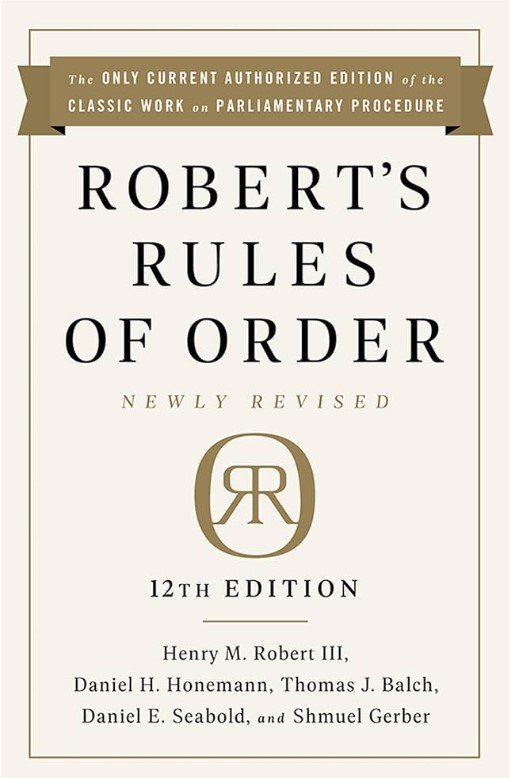
Please use these Parliamentary Pointers to help guide you through your chapter meetings! Click here for a downloadable version that can be printed.
Who is the Society?
RONR (12th ed.) 1:1
A deliberative assembly – the kind of gathering to which parliamentary law is generally understood to apply – has the following distinguishing characteristics: It is a group of people, having or assuming freedom to act in concert, meeting to determine, in full and free discussion, courses of action to be taken in the name of the entire group.
Who Can Add Items to the Agenda?
RONR (12th ed.) 41:62
“Unless a pre-circulated agenda is formally adopted at the session to which it applies, it is not binding as to detail or order of consideration…”
RONR (12th ed.) 41:63
Changing an Agenda. When the adoption of a proposed agenda is pending, it is subject to amendment by majority vote. After an agenda has been adopted by the assembly, no change can be made except by a two-thirds vote, a vote of majority of the entire membership, or unanimous consent. An affirmative vote to adopt an agenda may not be reconsidered.
Who Can Make A Motion?
RONR (12th ed.) 1:4
A member of an assembly, in the parliamentary sense,… is a person entitled to full participation in its proceedings, that is,… the right to attend meetings, to make motions, to speak in debate, and to vote.
No member can be individually deprived of these basic rights of membership… except through disciplinary proceedings.
Rules of Debate
RONR (12th ed.) 4:28
In the debate, each member has the right to speak twice on the same question on the same day, but cannot make a second speech on the same question so long as any member who has not spoken on that question desires the floor. A member who has spoken twice on a particular question on the same day has exhausted her right to debate that question for that day.”
RONR (12th ed.) 4:29
Without the permission of the assembly, no one can speak longer than permitted by the rules of the body – or, in a non-legislative assembly that has no rule of its own relating to the length of speeches, longer than ten minutes.”
Duties of the Presiding Officer (Regent):
RONR (12th ed.) 47:7 (10)
Q: What if my Chapter Regent and/or Recording Secretary refuses to sign the adopted motion?
A: Robert’s Rules of Order, 12th Edition, Section 47.7 states, in part, that a duty of the presiding officer includes authenticating by her signature, when necessary, all acts, orders, and proceedings of the assembly. The Regent’s signature on the adopted resolution is simply an authentication/affirmation of the action taken by the Chapter and is not a representation of the Regent’s personal opinion. The same holds true for the Secretary as she is the custodian of the records.
When your Chapter Regent and Recording Secretary were installed as officers they swore an oaththat they “accept the responsibilities and duties of the office they now assume.”They also promised to “faithfully perform the duties of their office to the best of their ability and understanding, God being their helper.”
RONR (12th ed.) 4:16
If the chair rules that a motion is not in order, her decision is subject to an appeal to the judgment of the assembly.”
The Role of the Parliamentarian:
RONR (12th ed.) 47:55
A member of an assembly who acts as parliamentarian has the same duty as the presiding officer to maintain a position of impartiality, and therefore does not make motions, participate in debate, or vote on any question except in the case of a ballot vote. She does not cast a deciding vote, even if her vote would affect the result, since that would interfere with the chair’s prerogative of doing so. If a member feels that she cannot properly forgo these rights in order to serve as parliamentarian, she should not accept that position. Unlike the presiding officer, the parliamentarian cannot temporarily relinquish her position in order to exercise such rights on a particular motion.
Improper Motion (potentially):
RONR (12th ed.) § 17 LAY ON THE TABLE
Q: What if a motion is made to “table” the motion or “lay the motion on the table”?
A: You have a few choices. You can interrupt to say “Point of Order” which the chair knows is a violation complaint.
The motion to Lay on the Tableenables the assembly to lay the pending question aside temporarily when something else of immediate urgencyhas arisen or when something else needs to be addressed before consideration of the pending question is resumed…
This motion is commonly misused in ordinary assemblies-in place of a motion to Postpone Indefinitely (11), a motion to Postpone to a Certain Time (14), or other motions. Particularly in such misuses, it also is known as a motion “to table.”
By adopting the motion to Lay on the Table, a majority has the power to halt consideration of a question immediately without debate. Such action violates the rights of the minority and individual members if it is for any other purpose than the one stated in the first sentence of this section.
In ordinary assemblies, the motion to Lay on the Table is not in order if the evident intent is to kill or avoid dealing with a measure. If a time for resuming consideration is specified in making the motion, it can be admitted only as a motion to Postpone (14), in which case it is debatable.
A motion can be made to postpone to a later date and members can debate on this before a vote is taken.
Remember, a motion to Postpone Indefinitely is a motion to kill the question and is also debatable.
Q: If a motion (question) has been “Laid on the Table”, how does the assembly “Take it from the Table?”
A: First, remember that if a motion has been “laid on the table” it should only have been done because it was necessary to deal with a more urgent matter, and should not have been used as a means to kill or avoid dealing with the motion.
A motion to “Take from the Table” can be made during the same meeting after the urgent matter has been handled.
A member will make a make a motion at that time… “I move to Take from the Table the motion relating to adopting the Resolution for the Call of the Special Meeting…”
Or, this can be done at the next Regular Meeting (so long as it is within the quarterly time interval), usually under Unfinished Business… “I move to Take from the Table the motion relating to adopting the Resolution for the Call of the Special Meeting…”
This can also be done at a Special Meeting of your chapter if the call of the Special Meeting specifies either the particular question that lies on the table or its subject matter.
This motion to “Take from the Table” requires a second, it is not debatable, and requires a majority vote.
DUTIES OF DELEGATES
RONR (12th ed.) 58:18
When a member of a constituent unit has accepted election as a delegate, he has the obligation to attend the convention, with such expense allowance as the unit may provide; she should not leave it to an alternate to serve in her place except for serious reason. At the convention, the delegate has the duty to be present at the business meetings, and to be prepared on returning from the convention to present to her unit an information report of what transpired. A delegate is free to vote as she sees fit on questions at the convention, except as her constituent unit may have instructed her in regard to particular matters scheduled for consideration.
Customs/Customary Practices
RONR (12th ed.) 2:25
In some organizations, a particular practice may sometimes come to be followed as a matter of established custom so that it is treated practically as if it were prescribed by a rule. If there is no contrary provision in the parliamentary authority or written rules of the organization, such an established custom is adhered to unless the assembly, by a majority vote, agrees in a particular instance to do otherwise. However, if a customary practice is or becomes in conflict with the parliamentary authority or any written rule, and a Point of Order citing the conflict is raised at any time, the custom falls to the ground, and the conflicting provision in the parliamentary authority or written rule must thereafter be complied with. If it is then desired to follow the former practice, a special rule of order (or, in appropriate circumstances, a standing rule or bylaw provision) can be added or amended to incorporate it.
No Responses